


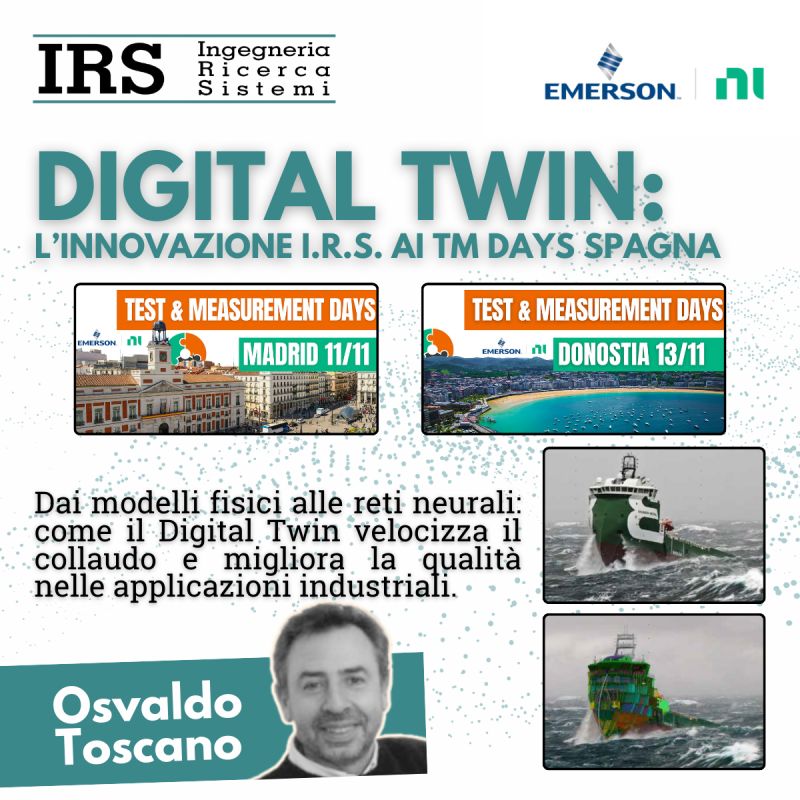
Digital transformation is profoundly changing the way industrial companies design, manufacture, and validate their products. Among the technologies playing an increasingly important role in this process, the Digital Twin represents one of the most promising solutions for making test systems smarter, more efficient, and more predictive.
It was precisely on this topic that IRS Srl shared its expertise during the Spanish leg of the Test & Measurement Days, the events organized by MeasureIT dedicated to the most innovative technologies and applications in the world of Test & Measurement. During the events, Osvaldo Toscano presented the work developed by IRS in the field of Digital Twin technology applied to industrial testing, focusing in particular on a use case involving end-of-line testing of commercial refrigerators.
Participating in these events provided an important opportunity to share with industry professionals and companies an innovative approach to testing, in which digital simulation is integrated with data coming directly from physical systems. The goal is to create a more comprehensive test environment capable of simultaneously leveraging information collected from real sensors and data generated through digital models.
Traditionally, end-of-line testing is performed at the end of the production process to verify that each product meets the defined requirements and is ready to be released to the market. In an industrial setting characterized by high production volumes, this phase must necessarily be fast, reliable, and repeatable. Every second saved during testing can have a significant impact on line productivity, while the ability to promptly detect an anomaly can prevent non-conforming products from continuing through the production process.
It is in this context that the integration of the Digital Twin can open up new possibilities. In the case presented by IRS Srl, the Digital Twin is applied to the testing of commercial refrigerators through the combined use of physical models and neural networks. This approach makes it possible to digitally represent the product’s behavior and to use the data collected during physical testing to improve the system’s analytical capabilities.
One of the most interesting aspects of the solution is the integration of real sensors and virtual sensors. Real sensors collect information directly from the device under test, while virtual sensors provide estimates and additional information through data processing and digital models. Combining these two sources makes it possible to expand the amount of information available during testing without necessarily increasing the number of physical sensors installed on the product or the duration of the tests.
First and foremost, this methodology can help detect defects more quickly. A traditional testing system is generally based on comparing measured values with specific acceptance limits. The use of digital models and neural networks, on the other hand, allows for a more in-depth analysis of the product’s behavior, identifying any deviations from what the model considers normal.
The ability to detect abnormal behavior more quickly can have a significant impact on production line efficiency. Identifying a problem early in the testing phase allows for prompt action, reducing the risk of additional processing or nonconforming products advancing to later stages of the process.
Another advantage relates to improved testing decisions. The availability of a digital model makes it possible to interpret the data collected during testing within a broader context. The system can therefore assist the operator or the automated process in evaluating the results, helping to more effectively distinguish between normal conditions and situations that require further verification.
The Digital Twin can also be used to generate predictive data, providing insight that goes beyond a simple snapshot of the product’s current state. By analyzing historical data and information collected during testing, it is possible to build models capable of estimating future behavior and identifying potential issues before they become actual problems.
This predictive capability also opens up new possibilities for quality management. Data from testing systems can, in fact, serve as a resource for better understanding the causes of anomalies, identifying recurring patterns, and progressively improving the production process. Testing is therefore no longer viewed merely as a final inspection phase but becomes part of a continuous cycle of information collection and analysis.
Another benefit is the ability to reduce testing time and costs. If the digital model can provide additional information and support data interpretation, certain testing activities can be optimized, either by reducing the number of tests required or by focusing the tests on conditions that are truly significant.
This approach can be particularly beneficial for companies that manage high-volume production lines, where even small reductions in cycle times can yield significant economic benefits. At the same time, greater testing efficiency must not compromise the reliability of the results. The integration of physical data and digital models is specifically designed to strike a balance between speed, accuracy, and the comprehensiveness of the tests.
IRS Srl’s presentation at the Test & Measurement Days in Spain thus highlighted how the Digital Twin can play a key role in the evolution of industrial testing systems. The integration of sensors, automation, physical models, neural networks, and data analysis makes it possible to build smarter test platforms capable of adapting to the needs of modern production processes.
For IRS Srl, innovation in testing hinges precisely on the ability to combine engineering expertise and digital technologies. The experience gained in developing Test & Measurement systems enables the company to tackle projects in which physical measurement and digital simulation work together to improve the quality and efficiency of processes.
Participation in the Spanish legs of the Test & Measurement Days also provided an important opportunity to engage with the professional community. Sharing experiences and concrete application examples demonstrates how emerging technologies can be transformed into solutions for real-world industrial problems.
The Digital Twin therefore represents one of the directions in which the future of industrial testing is heading. The ability to combine real and virtual data, anticipate potential anomalies, and support faster decision-making paves the way for more automated, predictive, and efficient testing systems.
Thanks to the integration of technology and engineering expertise, IRS Srl continues to work on developing solutions capable of taking testing to new levels of automation and intelligence. This is a journey in which the Digital Twin is not merely a virtual replica of the product, but a practical tool for transforming test data into useful information, improving processes, and building an increasingly efficient and future-oriented production system.
