


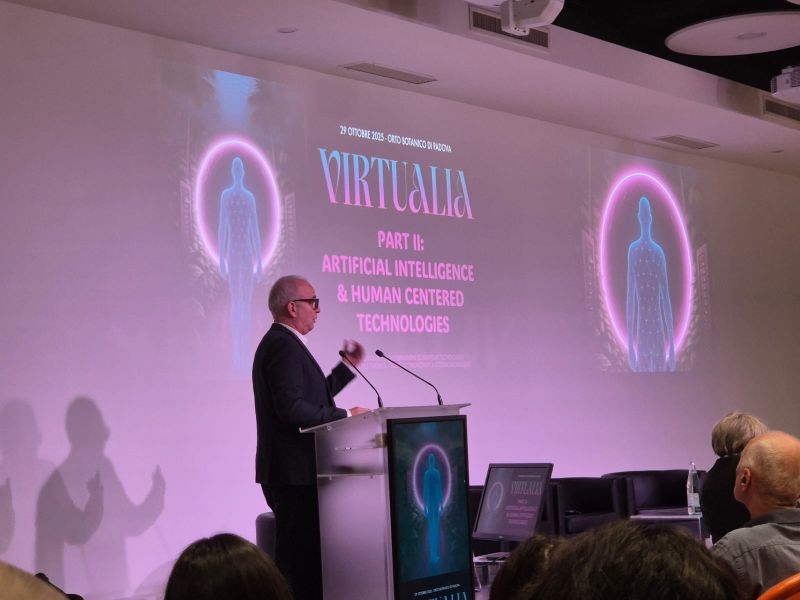
On October 29, 2025, IRS Srl participated in the second edition of Virtualia – AI & Human-Centered Technologies, an event dedicated to research and innovation organized by Spoke 5 of the iNEST project – Northeast Innovation Ecosystem. The event took place in a particularly picturesque setting, within the groundsof the Botanical Garden and the Biodiversity Garden at the University of Padua, bringing together researchers, businesses, students, professionals, and members of the public interested in the new frontiers of technology.
Virtualia serves as a forum where scientific research, technological innovation, and collaboration among different organizations come together to explore the potential of emerging technologies. The 2025 edition focuses on topics that are set to have an ever-greater impact on society and the industrial world, including Artificial Intelligence, Virtual Reality, Augmented Reality, and Mixed Reality, with a particular emphasis on the relationship between technology and people.
The concept of Human-Centered Technology is based on the idea that innovation should not be developed solely on the basis of the possibilities offered by technology, but must also take into account the needs, abilities, and experiences of the people who will use these solutions. The goal is to create technological systems capable of supporting human beings by improving processes, activities, and the quality of the experience.
For IRS Srl, participating in Virtualia was an important opportunity to share with the public and the research community two innovation projects developed through collaboration between companies and research centers. These projects demonstrate the importance of forging connections between the industrial and academic worlds to transform ideas and research findings into practical applications.
Collaboration between businesses and universities is, in fact, one of the main drivers of innovation. Companies bring expertise related to market needs, production processes, and real-world applications, while research centers contribute scientific expertise, advanced methodologies, and new technological perspectives. When these areas of expertise come together, they can give rise to solutions capable of addressing complex problems and generating new opportunities for development.
During the event, IRS Srl had the opportunity to present two projects that arose precisely from this type of collaboration. The company’s participation allowed it to share its innovation journey and highlight the value of the work carried out together with its partners.
One of the highlights of the day was the recognition received by one of the projects presented, which took a spot on the podium as part of the initiative. This significant achievement confirms the value of the activities carried out and the effectiveness of the collaboration among the various organizations involved.
This recognition holds special significance because it comes within a context specifically dedicated to research and innovation. Being selected and achieving a notable result at an event focused on emerging technologies means being able to share one’s work with a community interested in understanding how innovation can translate into practical applications.
IRS Srl’s experience at Virtualia also highlights how Artificial Intelligence is becoming increasingly prevalent in industrial innovation projects. AI can, in fact, be used to analyze large amounts of data, identify patterns, support decision-making processes, and develop systems capable of adapting to different situations.
In the fields of Test & Measurement and automation, these technologies can open up new possibilities. The combination of data from measurement systems, mathematical models, and artificial intelligence algorithms makes it possible to develop smarter, more predictive solutions capable of supporting engineers during development, validation, and testing activities.
At the same time, the human-centered approach reminds us that technology must be designed to be truly useful to its users. An advanced system must therefore not only be high-performing, but also understandable, accessible, and effectively integrated into work processes. This balance between technological innovation and a focus on people represents one of the most important challenges for the development of future technologies.
IRS Srl’s participation in the event also helped strengthen dialogue with the local community and the innovation ecosystem of the Northeast. The iNEST project serves as an important platform for collaboration among universities, businesses, and other local stakeholders, with the goal of promoting applied research and accelerating technology transfer.
Participating in initiatives of this kind allows companies to connect with different areas of expertise and organizations, creating new opportunities for collaboration. Engaging with researchers and professionals from diverse fields can, in fact, help generate new ideas and identify innovative approaches to addressing technological challenges.
For IRS Srl, this type of collaboration is particularly important. The company operates in an industry where technological innovation is a key factor and where expertise is constantly evolving. The opportunity to work alongside universities and research centers allows the company to explore new technologies and evaluate their potential applications in real-world industrial settings.
The Virtualia event also provided an opportunity to reflect on the future of technology and the role that Artificial Intelligence and immersive realities may play in the coming years. Virtual, Augmented, and Mixed Reality are, in fact, opening up new possibilities in the fields of training, design, maintenance, and remote collaboration.
Combining these technologies with AI can help create environments in which people can interact with digital information in a more natural and intuitive way. In an industrial setting, this could lead to new ways of visualizing data, supporting operators, and improving understanding of complex systems.
For IRS Srl, participating in Virtualia was therefore not only an opportunity to present its projects, but also a chance to discuss the future of innovation. The convergence of research, business, and society is, in fact, a fundamental element in developing technologies capable of meeting the real needs of the local community and its people.
IRS Srl would like to thank the authors and professionals who contributed to the projects presented, including Gianluca Bacchiega, Nicola Milani, and George Albu, as well as all the partners involved in the research and development activities. Special thanks also go to the Electrolux Group, specifically Marco Clara and Davide Rizzetto, for their collaboration and contribution to the innovation process.
We would also like to extend our heartfelt thanks to Luciano Gamberini and to everyone who helped make this initiative a reality, creating a space for people to meet and exchange ideas on emerging technologies.
This podium finish is a source of great satisfaction for IRS Srl and, at the same time, an incentive to continue investing in research and collaboration. Innovation, in fact, stems from the ability to combine diverse areas of expertise, experiment with new ideas, and transform research findings into concrete solutions.
Through its participation in research projects and initiatives such as Virtualia, IRS Srl continues to contribute to the development of an ecosystem in which technology, industry, and academia can collaborate to address the challenges of the future. This journey sees Artificial Intelligence, automation, and human-centered technologies as increasingly important tools for building innovation that is truly useful, sustainable, and people-oriented.