


The growing complexity of test and measurement systems is one of the main challenges that industrial companies face in their research, development, validation, and production processes. The number of connected devices is increasing, infrastructures are becoming increasingly distributed, and the volume of data generated by testing activities is growing rapidly. In this scenario, managing each system, device, or application individually can become difficult and inefficient.
To address this complexity, it is necessary to adopt a more structured approach, in which the various components of the infrastructure can be monitored, managed, and coordinated through a centralized platform. This is precisely the topic at the heart of the presentation on NI SystemLink during the 2025 Italian LabVIEW User Group event, where Nicola Milani illustrated the potential of a solution designed to simplify the management of modern Test & Measurement environments.
NI SystemLink is a platform that enables users to plan, manage, and optimize test and measurement systems through a centralized infrastructure. The goal is to create an environment in which software, devices, data, and processes can be managed in a coordinated manner, reducing fragmentation and increasing visibility across the entire test ecosystem.
The need for centralized management stems primarily from the growing prevalence of distributed infrastructure. In modern research and development laboratories and production environments, test systems can consist of numerous devices, computers, measuring instruments, and software applications. When these elements are managed separately, it becomes more difficult to maintain control over configurations, update systems, and verify the operational status of the equipment.
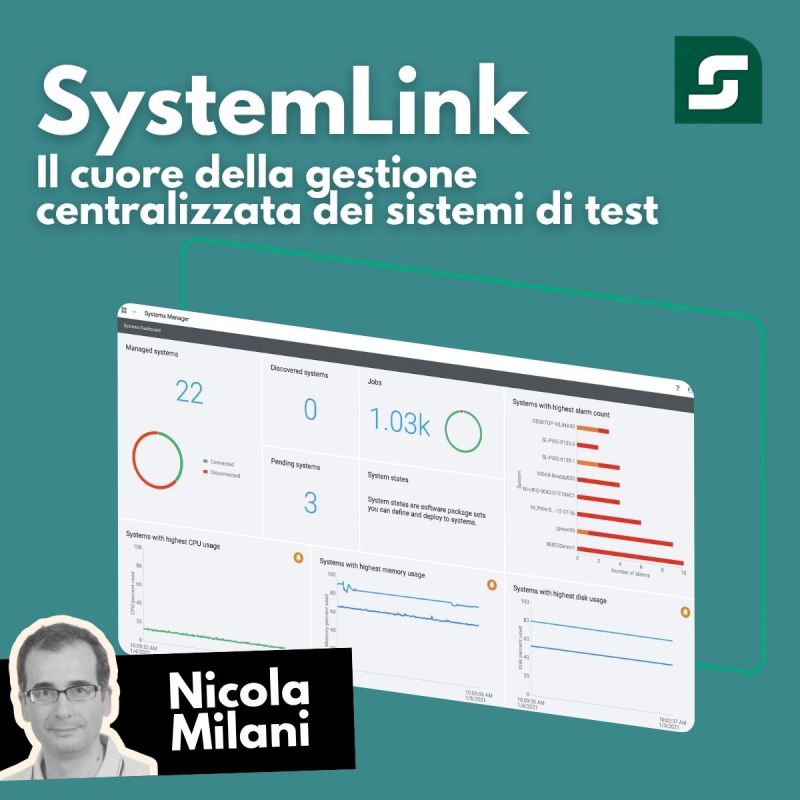
SystemLink introduces a unified web interface that allows for the centralization of numerous management tasks. Through a shared environment, engineers and IT managers can gain a more comprehensive view of the infrastructure and manage its various components in a more organized manner.
One of the most important aspects is the ability to securely deploy software and updates. In an infrastructure consisting of numerous systems, keeping all workstations up to date can require significant time and resources. Centralized management allows you to coordinate deployment activities, reducing the risk of inconsistent configurations and making it easier to maintain a consistent environment.
This aspect becomes even more important when testing systems are distributed across multiple laboratories or production sites. Centralized management allows for more consistent procedures and greater control over infrastructure development.
Another important feature is real-time monitoring of device status and tests. The ability to quickly view the operational status of the infrastructure makes it possible to identify any anomalies and take action before they can have a significant impact on processes.
Monitoring systems means not only being able to check whether a device is operational, but also understanding the overall status of the test environment. This visibility can help improve equipment availability and reduce the time required to resolve any issues.
SystemLink also enables users to work with artificial intelligence algorithms, analytics, and reporting, opening up new possibilities for leveraging the data generated during testing activities. The information collected by measurement systems can, in fact, be used not only to document test results but also to detect patterns, identify anomalies, and support more advanced decision-making processes.
The integration of systems management and data analysis represents an important step toward smarter test infrastructures. Data can become a strategic resource for better understanding product performance, optimizing processes, and identifying potential issues.
Another valuable feature is interactive dashboards, which allow information to be displayed clearly and immediately. Simply having data is not enough if it cannot be easily interpreted. Dashboards designed to meet user needs can help transform large amounts of information into useful metrics for monitoring performance and making decisions.
The centralized view also provides greater transparency into testing processes. Users can access the necessary information through a shared environment, improving collaboration among the various teams involved in engineering, quality, and production activities.
One of the main objectives of an infrastructure like SystemLink is precisely to promote greater integration between the laboratory and production. Traditionally, these two environments have been characterized by different tools, processes, and methodologies. Linking information and creating a shared infrastructure helps reduce this separation and promotes greater continuity throughout the product lifecycle.
The result is an ecosystem in which the data generated during the research and development phase can also be leveraged in subsequent phases, helping to create a seamless flow of information between design, validation, and production.
This approach can also have a positive impact on IT governance. Centralized system management, in fact, increases visibility into the technology infrastructure and enables the implementation of more structured procedures for managing software, updates, and resources.
For engineers, this means being able to spend less time on operational management tasks and focus more on activities that add greater value. For IT managers, on the other hand, it means having more effective tools to monitor and manage an increasingly complex technology environment.
During the 2025 Italian LabVIEW User Group event, Nicola Milani’s presentation demonstrated how SystemLink can serve as a technological framework capable of transforming complexity into greater clarity and control. Centralization does not simply mean bringing together different functions on a single platform, but rather creating an infrastructure in which systems, data, and people can work in a more coordinated manner.
For IRS Srl, these issues are closely linked to the evolution of test and measurement systems. In fact, the company supports its customers in developing testing solutions that are increasingly connected, automated, and focused on intelligent data management.
The growing digitization of industrial processes calls for a new approach to testing, in which measurement is merely the starting point. True value comes from the ability to manage the information generated, connect different systems, and transform data into knowledge.
NI SystemLink is part of this very evolution, offering an environment where management, monitoring, analysis, and visualization can converge within a single infrastructure. This approach can help companies improve the efficiency of their processes and build test systems that are more scalable and sustainable over time.
The insights shared during the 2025 Italian LabVIEW User Group event thus confirm the importance of investing in connectivity and centralized infrastructure management. In an industry where the number of systems and the volume of data continue to grow, having tools capable of maintaining control over the entire ecosystem is becoming increasingly strategic.
From software distribution to device monitoring, from data analysis to interactive dashboards, SystemLink offers an integrated view that connects the lab and production environments and supports the needs of both engineers and IT governance.
For IRS Srl, contributing to the widespread adoption of these technologies means continuing to promote an approach to Test & Measurement based on connectivity, automation, and data utilization. This journey leads from complexity to clarity and enables companies to transform their test infrastructures into smarter, more connected, and more efficient ecosystems.
