


In the world of Test & Measurement, software is a key element in transforming instruments, sensors, and data acquisition systems into truly effective solutions. The growing complexity of industrial, scientific, and infrastructure applications requires software platforms capable of handling large amounts of data, automating test procedures, and integrating with different systems and technologies.
To meet these needs, IRS Srl develops customized and scalable software solutions designed to support customers throughout all phases of a test system’s lifecycle. From defining the architecture to building the application, and on through to maintaining and evolving the platform, the goal is to create robust, flexible tools capable of adapting to future needs.
IRS's approach combines software engineering expertise with knowledge of test and measurement processes. This integration enables the development of applications that go beyond simply controlling instruments or acquiring data; rather, they are designed to be integrated into complex industrial and technological processes, helping to improve their efficiency and reliability.
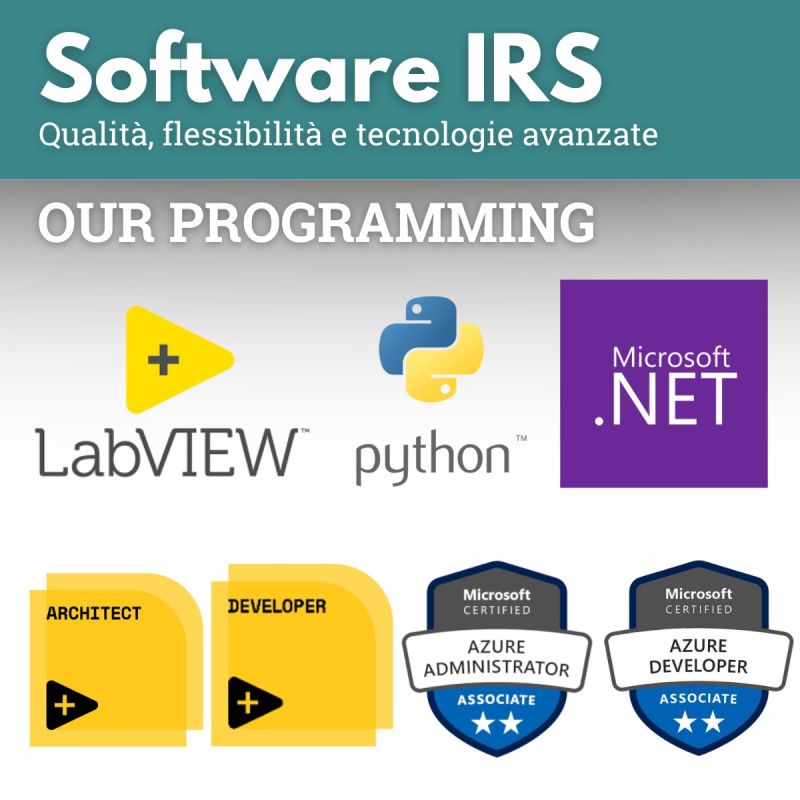
One of the distinctive features of IRS’s software offerings is the ability to use different development environments, selecting the most appropriate technology based on the project’s characteristics. The main languages and frameworks used include LabVIEW, Microsoft .NET, and Python. The availability of cross-functional expertise allows us to tackle a wide variety of applications and develop software architectures capable of interfacing with existing infrastructure and new digital platforms.
LabVIEW is one of the leading tools for developing systems for test and measurement and automation. Its integration with data acquisition and measurement hardware enables the creation of applications for system control, automated test management, and data acquisition from various sensors and instruments.
Using LabVIEW also makes it possible to develop intuitive user interfaces and systems designed to manage complex test procedures. In an industrial setting, this can lead to the ability to automate repetitive tasks, reduce manual intervention, and improve the repeatability of tests.
In addition to LabVIEW, IRS uses Microsoft .NET to develop custom software applications and systems integrated with corporate IT infrastructure. The technologies in the .NET ecosystem enable the creation of modular and scalable applications, facilitating integration with databases, web services, management systems, and other software platforms.
This ability to interconnect is becoming increasingly important in modern manufacturing environments. Test systems are no longer isolated entities; they must be able to communicate with the rest of the company’s digital infrastructure. The data generated during testing can, in fact, be used to feed centralized databases, quality management systems, and platforms dedicated to performance analysis.
Another key element of the IRS approach is the use of Python, a particularly versatile and widely used language in the fields of science and technology. Its flexibility makes it well-suited for developing tools for data processing, advanced analysis, and integration with libraries and technologies related to artificial intelligence and machine learning.
The combination of LabVIEW, .NET, and Python therefore makes it possible to build hybrid software architectures, in which each technology is used to leverage its own strengths. This flexibility allows for the development of customized solutions without limiting the project to a single technology environment.
A key aspect of IRS’s software development process is its Quality Management System, which complies with the ISO 9001 standard. The adoption of a structured system makes it possible to define and monitor development processes, ensuring an approach focused on quality and the continuous optimization of activities.
For a software project intended for industrial applications, quality is not limited to the application’s functionality. It is also necessary to ensure traceability, reliability, documentation management, and the ability to maintain the system over time. A structured process allows these aspects to be addressed systematically, reducing risks and improving the overall quality of the result.
This approach is complemented by the use of an Agile methodology, which allows for flexible and transparent management of the development process. A project’s requirements may, in fact, evolve during the development process and call for changes or new features. An Agile process makes it possible to gather ongoing feedback and adapt the development to the client’s actual needs.
Ongoing collaboration between the development team and the client makes it possible to periodically review the results achieved and promptly identify any issues. This approach helps improve communication, reduce development time, and ensure that the final product better aligns with the initial objectives.
The combination of ISO 9001 and Agile methodology thus makes it possible to reconcile two seemingly different requirements: on the one hand, the need to maintain structured, quality-oriented processes; on the other, the ability to adapt quickly to change. The result is a development process that aims to ensure reliability without sacrificing flexibility.
IRS’s software capabilities are applied in numerous fields. In the industrial sector, the platforms can be used to automate test systems, validate products, and manage data acquisition processes. In the scientific field, the solutions can support complex experiments and advanced measurement systems. In the infrastructure sector, the software can contribute to the continuous monitoring and management of large amounts of data from distributed sensors.
In all these contexts, the ability to develop customized solutions is a key factor. Each application has different requirements and calls for an architecture designed to meet specific operational needs. Truly effective software must be able to evolve alongside the system it controls and integrate with technologies that will be introduced in the future.
Scalability therefore becomes a fundamental requirement. A system designed today must be able to support an increase in the number of devices, sensors, and data without requiring a complete redesign of the architecture. A modular design allows for the addition of new features and the integration of new technologies while maintaining a consistent structure.
For IRS Srl, software development is therefore a strategic component of its Test & Measurement system design business. The combination of technical expertise, structured methodologies, and an understanding of industry needs enables the company to create robust, modern, and future-oriented platforms.
In a world where automation, digitization, and data analysis are profoundly transforming industrial processes, having reliable, customized software is becoming increasingly important. Applications must be able to connect tools and people, transform raw data into useful information, and support faster, more informed decisions.
Thanks to its experience with LabVIEW, Microsoft .NET, and Python, and a development process based on quality and Agile methodology, IRS Srl continues to design software solutions capable of meeting the needs of increasingly complex test and measurement systems.
The goal is to develop platforms that are not merely software tools, but technological components integrated into the customer’s processes: solutions that are reliable today, but above all designed to grow, evolve, and support industrial innovation for years to come.